Side quests
I am still well ahead on my sprint plan, so have allowed myself some time to play about with other things.
Parish Councils
Finally got round to finishing collating a list of all the parish councils and meetings. You’d think it would be easy to find one, but whilst there is reliable parish data, not all parishes have one and what lists there are are hidden on district council websites. I’ve always thought there should be one. I got a search agent swarm to gather the remaining URLs and had fun verifying those that I couldn’t automatically check. Whilst they have slowly switched over to .gov.uk domains, there are some that still look like they were built for Geocities, which has made me feel old. When I added an export of the data to Google Drive, my account got flagged for malware thanks to one of the council websites. It’s fine now (I had already run the file against the Safe Browsing API with no issues) but must have been compromised at some point. I took that one out before sending it on, just in case, and have asked for a human review.
International Organisations
I finished putting this together for confirmordeny. Getting the basic version up was a catalyst to them adding more data and doing the assessments, which has been pleasing to watch.
Presidio
I was cleaning up my drive and found a fine tuned NER model that I’d not got around to testing. It is designed to run in presidio to detect PII in files. The default model en_core_web_lg catches most personal data, but only because it flags nearly everything. The sample set I ran it on was too small to know whether the fine-tuned model’s advantage holds at scale.
| Model | TP | FP | FN | Precision | Recall | F1 |
|---|---|---|---|---|---|---|
| red_actinia_v4 | 109 | 40 | 29 | 73.2% | 79.0% | 76.0% |
| spacy:en_core_web_lg | 100 | 2,839 | 38 | 3.4% | 72.5% | 6.5% |
Fossils
Now that the fossil from the weekend has been cleaned and dried, I’m slightly less certain as to what it is. It is really different from my other one, and in a much worse condition.
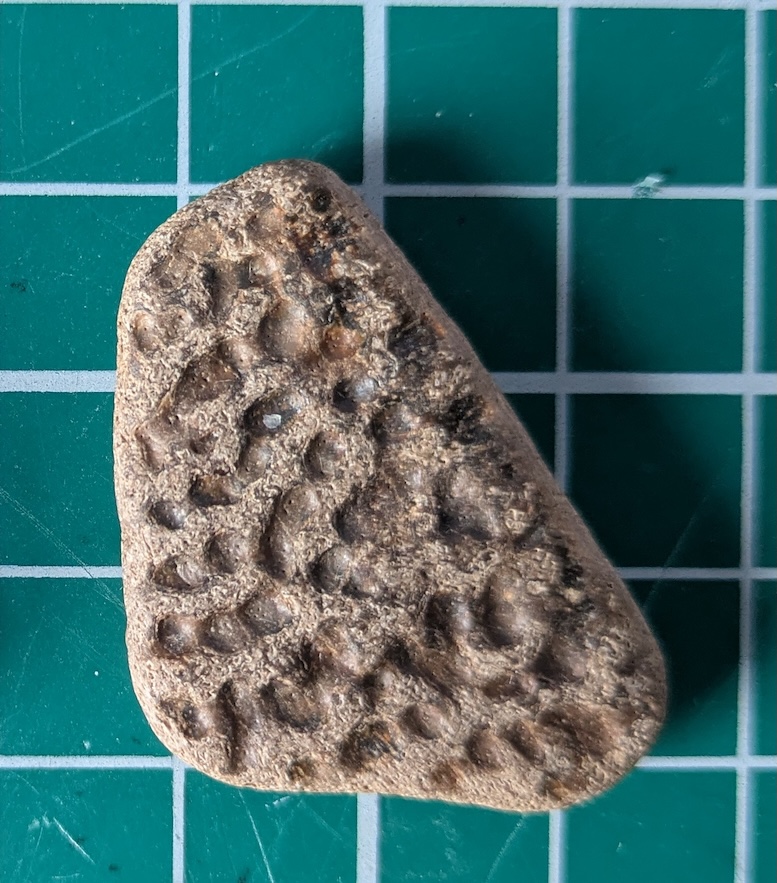
Crocodile ones can look quite similar, but I’m still strongly leaning towards it being trionyx because of the back and the shape/spacing/depth of the pits. Either way, I like looking at it. Thirty-five million years ago it lived right here, and deep time has a way of making everything else feel appropriately small.
Swarms
At the weekend I was talking to my partner about corporate tax strategy disclosures and got curious about something. Less than an hour later I had a copy of every published strategy from all FTSE-100 and FTSE-250 companies and had run various bits of analysis. I found myself doing a similar thing with council FOI pages yesterday.
Gathering and processing information used to take a long enough time that it acted as a bit of a natural regulator. Now the real bottleneck to progress is me. The agents don’t get tired, but I do. I try to be disciplined about it, and when a swarm is running, I try to make myself go and do something else. Today I caught myself with four Claude Code instances open across three different projects, which is not ideal in the long run. When everything is cheap to start, rather than inertia being the issue, the harder skill becomes not starting things you then feel pressured to finish.
The productivity gain from agents is real, but if you start context-switching between their outputs too much, you might end up not paying enough attention to part of the process that still needs a human, which is checking that the output is actually good. The ease of spinning things up makes it dangerously easy to let everything turn into a side quest. I think that sometimes the most productive thing is knowing when to stop.